Introduction
Bianbu is an operating system deeply optimized for RISC-V architecture processors, built on the Ubuntu community source code, and provides a system foundation for iterative spatiotemporal AI CPUs. Bianbu provides the following version images for developers and users:
- GNOME Desktop Version: The native desktop version comes pre-installed with the GNOME Shell desktop environment, Chromium, LibreOffice, MPV, and other applications.
- LXQt Desktop Version: A lightweight desktop redesigned and developed based on LXQt, designed for lightweight scenarios with requirements for resource consumption and performance.
- Minimal Version: Minimal system version, providing a command-line interface.
Why Bianbu?
- Provide developers with an operating system deeply optimized for RISC-V architecture processors
- Provide customers with system solutions to accelerate product mass production
- Drive the development of the RISC-V hardware and software ecosystem
Vision
To empower every individual and every industry around the world with our technology and services.
System Architecture
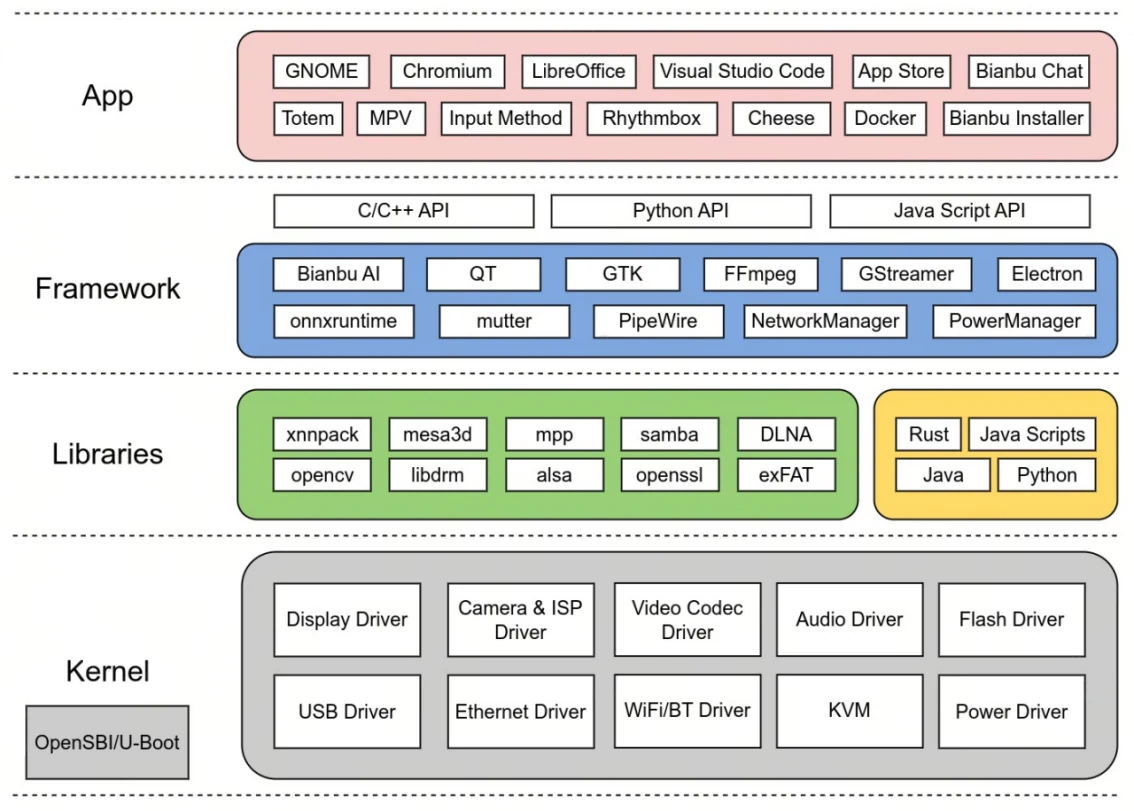
Software Components
Bianbu is composed of the following key components:
- Applications
- Frameworks
- Runtimes
- Libraries
- Linux Kernel
- U-Boot
- OpenSBI
Bianbu manages the packages of these components through the APT source, using the standard Debian package format.
Applications
- GNOME/LXQt desktop and its common applications
- Remote desktop
- Chromium browser
- LibreOffice suite
- Visual Studio Code
- Docker
Frameworks
Application Frameworks
- Electron
- GTK
- Qt
Multimedia Frameworks
- FFmpeg (with Hardware Accelerated)
- GStreamer (with Hardware Accelerated)
- PipeWire
Inference Frameworks
- onnxruntime (with Hardware Accelerated)
Runtimes
- Python
- Java
- Node.js
- Rust
Libraries
- OpenCV (with RVV Accelerated)
- OpenSSL (with Hardware Accelerated)
- MPP (multimedia processing platform with C API and samples)
- Mesa 3D
- OpenGLES/Vulkan/OpenCL
Linux Kernel
The Linux kernel is responsible for managing the processor and other hardware resources, providing an interface between users and applications and the hardware. Its main functions include:
- Interrupt and clock management
- Process scheduling
- Memory management
- File system management
- Device driver management
- Network protocol stack
Supported versions and source links:
U-Boot
U-Boot is a bootloader responsible for initializing specific hardware and loading the Linux kernel image, device tree, and initial RAM filesystem from media (such as SD card, eMMC, SPI Flash, SSD, network).
OpenSBI
OpenSBI is an implementation of the Supervisor Binary Interface for RISC-V architecture processors, running in M-mode firmware, providing interfaces for bootloaders, hypervisors, and operating systems to access hardware.
Supported versions and source links:
Supported Devices
K1
- BPI-F3
- Milk-V Jupiter
- MUSE Card
- MUSE Pi
- MUSE Pi pro
- MUSE Box
- MUSE Book
K3
- Pico ITX
- CoM260 Kit
Release Information
-
Bianbu 1.0 (End of Life)
-
Bianbu 2.x (K1 Long-Term Maintenance Version)
-
Bianbu 4.x (K3 only)