Linux DMA-BUF Debugging Guide
1. Introduction
DMA-BUF is a solution provided by Linux kernel for the issue: how to efficiently and securely share large memory buffers between different drivers and subsystems.
Before the advent of DMA-BUF, every driver that required shared memory (e.g. graphics driver, video codec, camera driver) had its private sharing mechanism. This resulted in massive redundant development and compatibility issues.
For example, the DMA-BUF architecture in drm_gem is as follows:
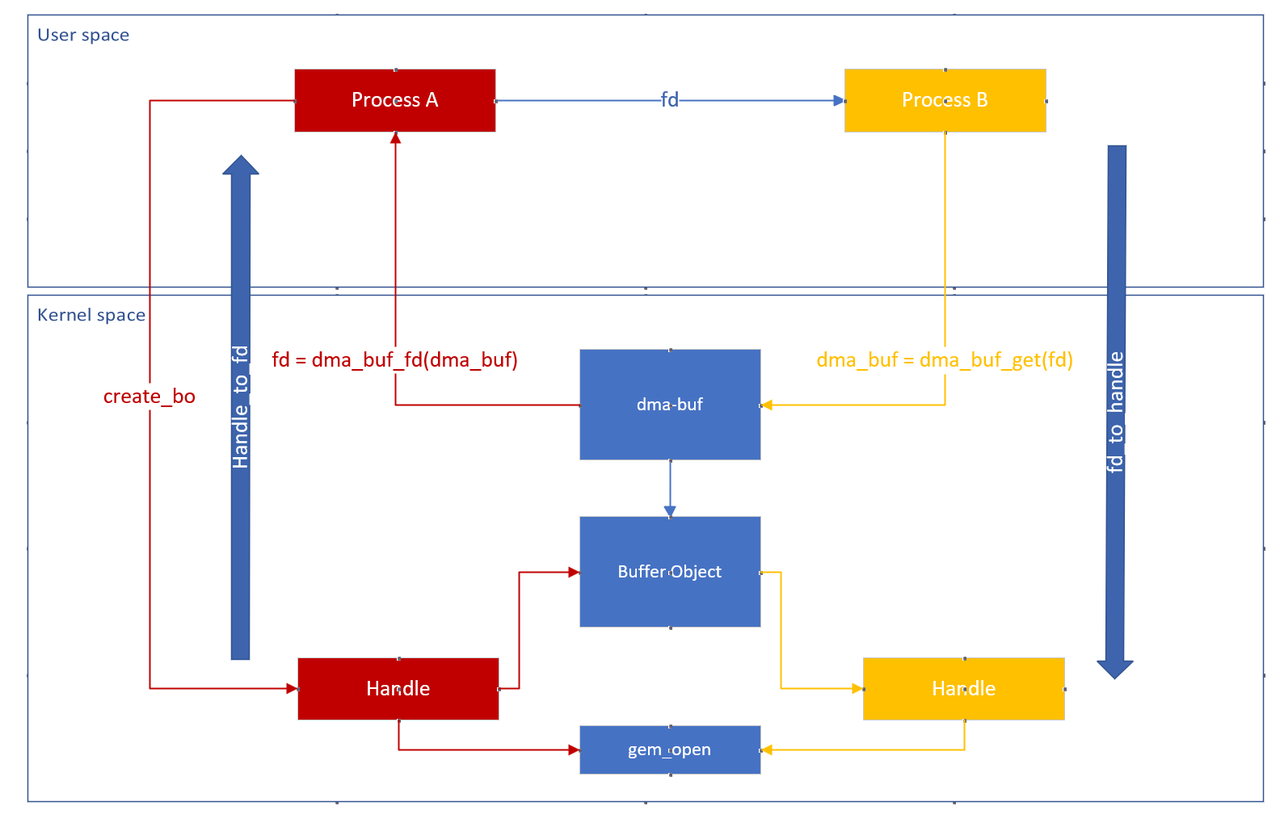
2. Core Mechanism
By providing a standard set of APIs and objects, the DMA-BUF framework separates buffer "ownership" and "usage rights" to establish a unified sharing model.
- File descriptor abstraction:
DMA-BUF binds physical buffers and file descriptors (FDs), enabling shared transfer across processes or devices via FDs. - Role-separated architecture:
- Exporter: It allocates memory and implements the
dma_buf_opsoperations, including interfaces such asmap_dma_buf,begin_cpu_access. - Importer: It obtains buffers' device address (e.g. IOVA) via
dma_buf_attachanddma_buf_map_attachment, enabling direct hardware access.
- Exporter: It allocates memory and implements the
- Synchronization Mechanism:
Asynchronous operations are synchronized viadma-fenceanddma-resvto ensure data consistency during multi-device access.
3. Usage Method
3.1 Kernel Configuration
CONFIG_DMA_SHARED_BUFFER=y
3.2 Exporter
 static struct dma_buf *jpu_exp_alloc(struct jpu_alloc_dma_buf *alloc_data)
  {
      // Calculate the required pages
      size = alloc_data->size;
      npages = PAGE_ALIGN(size) / PAGE_SIZE;

      // Allocate the data structure
      data = kmalloc(sizeof(*data) + npages * sizeof(struct page *), GFP_KERNEL);

      // Allocate the physical pages
      for (i = 0; i < npages; i++) {
          data->pages[i] = alloc_page(GFP_KERNEL);
      }

      // Configure the export information
      exp_info.ops = &jpu_dmabuf_ops;
      exp_info.size = npages * PAGE_SIZE;
      exp_info.priv = data;

      // export dma-buf
      dmabuf = dma_buf_export(&exp_info);
      return dmabuf;
  }
The above example implements JPU memory allocation logic, allocating the corresponding physical pages according to requirement size. After allocation, it calls dma_buf_export to encapsulate these pages into a dma-buf object and then export it to the system.
3.3 Importer
  static int get_addr_from_dmabuf(struct v2d_info *v2dinfo,
                                 struct v2d_dma_buf_info *pInfo,
                                 dma_addr_t *paddr)
  {
      // Attach dma-buf to device
      pInfo->attach = dma_buf_attach(pInfo->dmabuf, dev);

      // Map attachment
      pInfo->sgtable = dma_buf_map_attachment_unlocked(pInfo->attach, DMA_BIDIRECTIONAL);

      if (sgt->nents == 1) {
          addr = sg_dma_address(sgt->sgl);  // Contiguous memory
      } else {
          // Multi-segment memory use IOMMU
          addr = V2D_TBU_BASE_VA + (dma_addr_t)(pInfo->tbu_id)*V2D_TBU_VA_STEP;
          size = v2d_iommu_map_sg(addr, sgt->sgl, sgt->orig_nents, flags);
      }

      *paddr = addr;
      return 0;
  }
V2D receives a dma-buf, attaches it to its own device, and then maps it to obtain a physical address (or IOMMU address) accessible to its hardware.
3.4 Interaction Logic
DMA-BUF Interaction flow
The core of dma-buf is to achieve "zero-copy" memory sharing between different drivers through a file descriptor (fd).
- Export and Transfer: JPU (exporter) allocates memory and exports an fd to a userspace application. The application then transfers it to the V2D (importer).
- Import and Usage: V2D uses the FD to locate and map the memory, obtaining a physical address (or IOVA generated by the IOMMU) directly accessible by its hardware to process data directly.
- Release: When both V2D and the userspace application have released their reference to the fd, the JPU automatically calls back and releases the original allocated memory.
4. Debugging Method
4.1 /sys/kernel/dmabuf/buffers/
Usage Method
After enabling CONFIG_DMABUF_SYSFS_STATS, an interface will be created under '/sys/kernel/dmabuf/buffer/'.
- Each subdirectory includes two files:
exporter_name: Records the driver name that exported thedma-buf(e.g.dma-buf-heapori915).size: Records the size of thedma-buf(in bytes)
- When a
dma-bufis destroyed, its corresponding directory is automatically removed.
Troubleshooting
- You can inspect the number of entries under
/sys/kernel/dmabuf/buffers/to confirm whether there is adma-bufleak. - Count the number of
dma-bufcreated by each exporter to identify the source of leak.
4.2 /sys/kernel/debug/dma_buf/bufinfo
Example Export
size            flags           mode            count           exp_name        ino             name
08847360        00000002        00080007        00000003        drm                00000089        1769-gnome-shell
        write fence:drm_sched gfx seq 12146 signalled
        Attached Devices:
Total 0 devices attached
- size: buffer size;
- flags: flags for the file descriptor (
00000002corresponds toO_RDWR, representing the buffer is opened in read-write mode); - mode: access authority mode of the file;
- count: reference count of the buffer;
- exp_name: name of the driver that exported this DMA-BUF;
- ino: inode number of the file;
- name: Name set for this buffer by Userspace;
write fence: ... signalled:indicates a write fence.signalledmeans the corresponding asynchronous operation (such as GPU rendering) has completed. If it remainsunsignalledfor a long time, a GPU hang may exist.Attached Devices:lists all devices attached to this DMA-BUF. (The value is 0 in the example.)
Troubleshooting
- Debugging system freezes or application hangs: When the write fence on a display buffer remains
unsignalledfor an extended period, it typically indicates a GPU hang.