DMA
This document describes DMA controller configuration and how peripherals use DMA through DMA-Slave.
Overview
DMA (Direct Memory Access) is a high-speed data transfer method that does not require direct CPU control. It establishes a hardware data path between the source and destination addresses, thereby improving system efficiency.
This module covers the DMA controller (that is, the DMA master), which is mainly responsible for scheduling DMA channel resources and carrying out data-transfer tasks.
Functionality
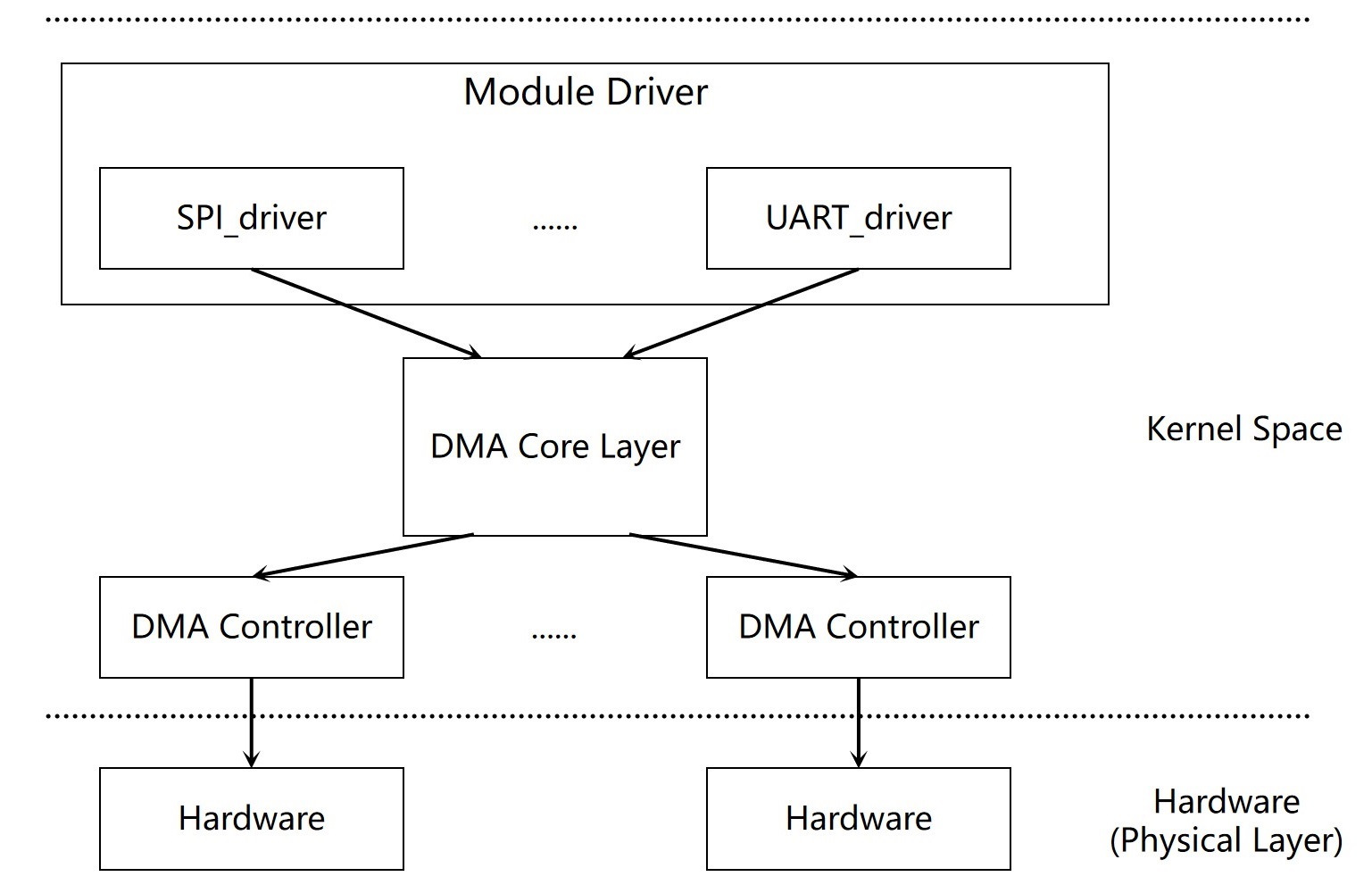
By combining the DMA framework with the K3 platform DMA controller driver, the following transfer directions are supported:
- Memory-to-memory
- Memory-to-peripheral
- Peripheral-to-memory
It also supports the following three transfer forms:
- Memory copy
- Scatter-gather transfer
- Ring buffer transfer
Source Code Structure
DMA controller-related source code is located in the drivers/dma directory:
drivers/dma
|--dmaengine.c dmaengine.h      # Kernel DMA framework code
|--dmatest.c                    # Kernel DMA test code
|--mmp_pdma.c                   # K3 PDMA controller driver
The PDMA driver file used on K3 is mmp_pdma.c, with compatible = "spacemit,k1-pdma".
Key Features
Features
- Supports three transfer directions: memory-to-memory, memory-to-peripheral, and peripheral-to-memory
- Two PDMA controllers:
pdma(16 channels, enabled by default) andpdma1(16 channels, disabled by default, used for the secure domain) - Supported burst lengths: 8 / 16 / 32 / 64
- Maximum transfer size per descriptor: 8191 bytes
- Supports 64-bit addressing (LPAE, Long Physical Address Extension), allowing access to memory above 4 GB
- Supports data widths of 1 / 2 / 4 bytes
Configuration
It mainly includes driver enablement configuration and DTS configuration.
Kconfig Configuration
CONFIG_DMADEVICES: provides support for the kernel DMA framework. To support the DMA driver, this option should be set to Y.
Symbol: DMADEVICES [=y]
Device Drivers
      -> DMA Engine support (DMADEVICES [=y])
After enabling the platform DMA framework, set CONFIG_MMP_PDMA to Y to enable the K3 PDMA controller driver.
Symbol: MMP_PDMA [=y]
Device Drivers
      -> DMA Engine support (DMADEVICES [=y])
            -> MMP PDMA support (MMP_PDMA [=y])
The above options and CONFIG_DMATEST are all enabled in the K3 SDK defconfig.
DTS Configuration
Two things need to be completed in DTS: first, enable the PDMA controller node; second, declare dmas / dma-names on peripheral nodes that use DMA. This allows the driver to request the corresponding channels at runtime. Examples of both are given below.
DMA Controller Configuration Example
The Linux source file arch/riscv/boot/dts/spacemit/k3.dtsi already contains the DMA controller node. The following is an example written according to the DT binding recommendations:
pdma: pdma@d4000000 {
    compatible = "spacemit,k1-pdma";
    reg = <0x0 0xd4000000 0x0 0x4000>;
    interrupt-parent = <&saplic>;
    interrupts = <72 IRQ_TYPE_LEVEL_HIGH>;
    clocks = <&syscon_apmu CLK_APMU_DMA>;
    resets = <&syscon_apmu RESET_APMU_DMA>;
    #dma-cells= <1>;
    dma-channels = <16>;
    status = "okay";
};
This node declares the DMA register address, clock, reset resources, and the number of channels (16).
K3 also has a secure-domain PDMA controller, pdma1 (address 0xf0600000), which is disabled by default in the current DTS:
pdma1: pdma@f0600000 {
    compatible = "spacemit,k1-pdma";
    reg = <0x0 0xf0600000 0x0 0x4000>;
    interrupt-parent = <&saplic>;
    interrupts = <150 IRQ_TYPE_LEVEL_HIGH>;
    #dma-cells= <1>;
    dma-channels = <16>;
    status = "disabled";
};
Note: On K3,
#dma-cells = <1>, meaning that only the DMA request number needs to be specified. Therefore, when a device node references DMA resources, it should use the format one phandle + one request number, such asdmas = <&pdma 64>ordmas = <&pdma DMA_SSP0_TX>.
DMA-Slave Configuration Example
Taking SPI0 as an example, add the following properties under the SPI0 node. The macros DMA_SSP0_TX and DMA_SSP0_RX are defined in include/dt-bindings/dma/k3-dmac.h:
dmas = <&pdma DMA_SSP0_TX
        &pdma DMA_SSP0_RX>;
dma-names = "tx", "rx";
DMA Channel Mapping
The DMA request numbers for K3 PDMA are defined in include/dt-bindings/dma/k3-dmac.h. The main mappings are as follows:
| Peripheral | TX Request Number | RX Request Number |
|---|---|---|
| UART0 | 3 | 4 |
| UART2 | 5 | 6 |
| UART3 | 7 | 8 |
| UART4 | 9 | 10 |
| UART5 | 25 | 26 |
| UART6 | 27 | 28 |
| UART7 | 29 | 30 |
| UART8 | 31 | 32 |
| UART9 | 33 | 34 |
| UART10 | 53 | 54 |
| I2C0 | 11 | 12 |
| I2C1 | 13 | 14 |
| I2C2 | 15 | 16 |
| I2C4 | 17 | 18 |
| I2C5 | 35 | 36 |
| I2C6 | 37 | 38 |
| I2C8 | 41 | 42 |
| SSP3 | 19 | 20 |
| SSPA0 | 21 | 22 |
| SSPA1 | 23 | 24 |
| SSPA2 | 56 | 57 |
| SSPA3 | 58 | 59 |
| SSPA4 | 60 | 61 |
| SSPA5 | 62 | 63 |
| SSP0 | 64 | 65 |
| SSP1 | 66 | 67 |
| QSPI | 85 | 84 |
| CAN0 | — | 43 |
| CAN1 | — | 44 |
| CAN2 | — | 51 |
| CAN3 | — | 52 |
The channel mapping for pdma1 (secure domain) is defined by the DMA_SEC_* macros in the same header file and is used for secure-domain peripherals, such as SEC_UART1, SEC_SSP2, and SEC_I2C3.
Interface
API
The Linux kernel provides interfaces for managing DMA operations, including requesting DMA channels, configuring DMA transfers, preparing resources, starting transfers, and more.
Commonly used APIs include:
- Request a DMA channel
struct dma_chan *dma_request_chan(struct device *dev, const char *name)
- Configure channel parameters, such as transfer width, data size, and source/destination addresses
static inline int dmaengine_slave_config(struct dma_chan *chan,
                                          struct dma_slave_config *config)
- The following three interfaces prepare resources before starting a DMA transfer
dmaengine_prep_dma_memcpy
dmaengine_prep_slave_sg
dmaengine_prep_dma_cyclic
- Add the descriptor to the transfer task list
static inline dma_cookie_t dmaengine_submit(struct dma_async_tx_descriptor *desc)
- Start the transfer
static inline void dma_async_issue_pending(struct dma_chan *chan)
- Release the DMA channel
static inline void dma_release_channel(struct dma_chan *chan)
- Stop all transfers, for example when pausing audio playback
static inline int dmaengine_terminate_all(struct dma_chan *chan)
Testing
Since memory-to-device or device-to-memory data transfers require coordination with the peripheral driver—for example, when SPI transmits data, DMA must move the data from memory to the SPI TX FIFO, and SPI must trigger the DMA—testing usually focuses on memory-to-memory transfers. In this case, the kernel's built-in dmatest.c program can be used directly.
echo dma0chan8 > /sys/module/dmatest/parameters/channel  # Select an unused channel
echo 1 > /sys/module/dmatest/parameters/iterations  # Set the number of transfers; 1 is used as an example
echo 4096 > /sys/module/dmatest/parameters/transfer_size # Set the transfer size
echo 1 > /sys/module/dmatest/parameters/run   # Start the transfer
Note: Before using this test, make sure the kernel option
CONFIG_DMATESTis enabled. It is enabled by default in the K3 SDK defconfig.