4.3 C++ Inference Example
This section demonstrates how to perform model inference in a C++ environment using object detection as the example task. Object detection identifies both the location and category of objects in an image or video.
This example uses the YOLOv5 model running on the ONNX Runtime framework with SpacemiT hardware acceleration.
Clone the Code
git clone https://gitee.com/bianbu/spacemit-demo.git ~
Build and Run
cd spacemit_demo/examples/CV/yolov5/cpp
mkdir build
cd build
cmake ..
./yolov5_demo --model ../../model/yolov5_n.q.onnx --image ../../data/test.jpg
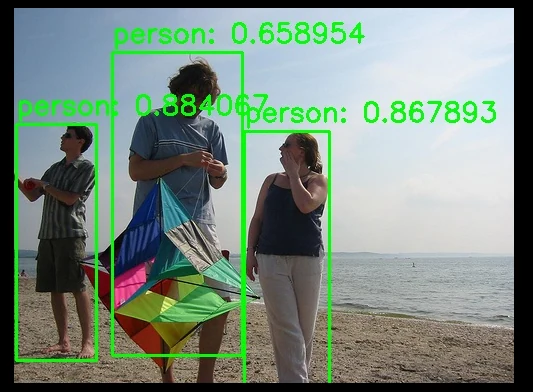
The inference results are saved as result.jpg by default. The following example shows detection results with bounding boxes:
Inference Process and Code Walkthrough
Header File Imports
#include <opencv2/opencv.hpp>
#include <onnxruntime_cxx_api.h>
#include "spacemit_ort_env.h"
Open the Camera
// Device ID defaults to 1
cv::VideoCapture cap(1);
if (!cap.isOpened()) {
    std::cerr << "Failed to open camera!" << std::endl;
    return -1;
}
Preprocess the Input Image
// Image preprocessing function
std::vector<float> preprocess(const cv::Mat& image, int inputWidth = 320, int inputHeight = 320) {
    cv::Mat resizedImage;

    // Resize the image to a fixed size
    cv::resize(image, resizedImage, cv::Size(inputWidth, inputHeight));

    // Convert the image channel order from BGR to RGB
    cv::cvtColor(resizedImage, resizedImage, cv::COLOR_BGR2RGB);

    // Normalize the image
    resizedImage.convertTo(resizedImage, CV_32F, 1.0 / 255.0);

    std::vector<float> inputTensor;

    // Convert the image channel order to [C, H, W]
    for (int c = 0; c < 3; ++c) {
        for (int h = 0; h < inputHeight; ++h) {
            for (int w = 0; w < inputWidth; ++w) {
                inputTensor.push_back(resizedImage.at<cv::Vec3f>(h, w)[c]);
            }
        }
    }
    return inputTensor;
}
Session Initialization and Preconfiguration
// Initialize the ONNX Runtime environment
Ort::Env env(ORT_LOGGING_LEVEL_WARNING, "YOLOv5Inference");
Ort::SessionOptions session_options;

// Set the runtime thread count. The maximum is 4.
session_options.SetIntraOpNumThreads(4)
session_options.SetGraphOptimizationLevel(GraphOptimizationLevel::ORT_ENABLE_ALL);

// Load the SpaceMIT EP
SessionOptionsSpaceMITEnvInit(session_options);

// Load the ONNX model
Ort::Session session_(env, modelPath.c_str(), session_options);

// Get the input node names
Ort::AllocatorWithDefaultOptions allocator;
std::vector<const char*> input_node_names_;
std::vector<std::string> input_names_;
size_t num_inputs_;
num_inputs_ = session_.GetInputCount();
input_node_names_.resize(num_inputs_);
input_names_.resize(num_inputs_, "");
for (size_t i = 0; i < num_inputs_; ++i) {
    auto input_name = session_.GetInputNameAllocated(i, allocator);
    input_names_[i].append(input_name.get());
    input_node_names_[i] = input_names_[i].c_str();
}
// Get the input width and height
Ort::TypeInfo input_type_info = session_.GetInputTypeInfo(0);
auto input_tensor_info = input_type_info.GetTensorTypeAndShapeInfo();
std::vector<int64_t> input_dims = input_tensor_info.GetShape();
int inputWidth = input_dims[3];
int inputHeight = input_dims[2];

// Get the output node names
std::vector<const char*> output_node_names_;
std::vector<std::string> output_names_;
size_t num_outputs_;
num_outputs_ = session_.GetOutputCount();
output_node_names_.resize(num_outputs_);
output_names_.resize(num_outputs_, "");
for (size_t i = 0; i < num_outputs_; ++i) {
    auto output_name = session_.GetOutputNameAllocated(i, allocator);
    output_names_[i].append(output_name.get());
    output_node_names_[i] = output_names_[i].c_str();
}

// Run image preprocessing
std::vector<float> inputTensor = preprocess(frame, inputWidth, inputHeight);

// Create the input tensor
auto memory_info = Ort::MemoryInfo::CreateCpu(OrtArenaAllocator, OrtMemTypeDefault);
Ort::Value input_tensor = Ort::Value::CreateTensor<float>(memory_info, inputTensor.data(), inputTensor.size(), input_shape.data(), input_shape.size());
Run Inference
std::vector<Ort::Value> outputs = session_.Run(Ort::RunOptions{nullptr}, input_node_names_.data(), &input_tensor, 1, output_node_names_.data(), output_node_names_.size());
Get Output and Post-process
// Get the output data
float* dets_data = outputs[0].GetTensorMutableData<float>();
float* labels_pred_data = outputs[1].GetTensorMutableData<float>();

// Get the number of detected objects
auto dets_tensor_info = outputs[0].GetTensorTypeAndShapeInfo();
std::vector<int64_t> dets_dims = dets_tensor_info.GetShape();
size_t num_detections = dets_dims[1];

// Get coordinates, scores, and labels separately
std::vector<std::vector<float>> dets(num_detections, std::vector<float>(4));
std::vector<float> scores(num_detections);
std::vector<int> labels_pred(num_detections);
for (size_t i = 0; i < num_detections; ++i) {
    for (int j = 0; j < 4; ++j) {
        dets[i][j] = dets_data[i * 5 + j];
    }

    scores[i] = dets_data[i * 5 + 4];
    labels_pred[i] = static_cast<int>(labels_pred_data[i]);
}
// Adjust bounding boxes to the original image dimensions
float scale_x = static_cast<float>(image_shape.width) / inputWidth;
float scale_y = static_cast<float>(image_shape.height) / inputHeight;
for (auto& det : dets) {
    det[0] *= scale_x;
    det[1] *= scale_y;
    det[2] *= scale_x;
    det[3] *= scale_y;
}
Visualize Results
void visualizeResults(cv::Mat& image, const std::vector<std::vector<float>>& dets, const std::vector<float>& scores, const std::vector<int>& labels_pred, const std::vector<std::string>& labels, float conf_threshold = 0.4) {
    for (size_t i = 0; i < dets.size(); ++i) {
        const auto& det = dets[i];
        float score = scores[i];
        if (score > conf_threshold) {
            int class_id = labels_pred[i];
            int x1 = static_cast<int>(det[0]);
            int y1 = static_cast<int>(det[1]);
            int x2 = static_cast<int>(det[2]);
            int y2 = static_cast<int>(det[3]);
            std::string label = labels[class_id];
            cv::rectangle(image, cv::Point(x1, y1), cv::Point(x2, y2), cv::Scalar(0, 255, 0), 2);
            cv::putText(image, label + ": " + std::to_string(score), cv::Point(x1, y1 - 10), cv::FONT_HERSHEY_SIMPLEX, 0.9, cv::Scalar(0, 255, 0), 2);
        }
    }
}